A drug can be scientifically validated, clinically effective, and officially approved by the FDA. Yet patients may still be unable to get it.
That sounds counterintuitive, especially to people outside the pharmaceutical industry. Approval is often portrayed as the decisive moment when a new medicine becomes available. In reality, approval is frequently only the beginning of a different and equally challenging phase: commercialization.
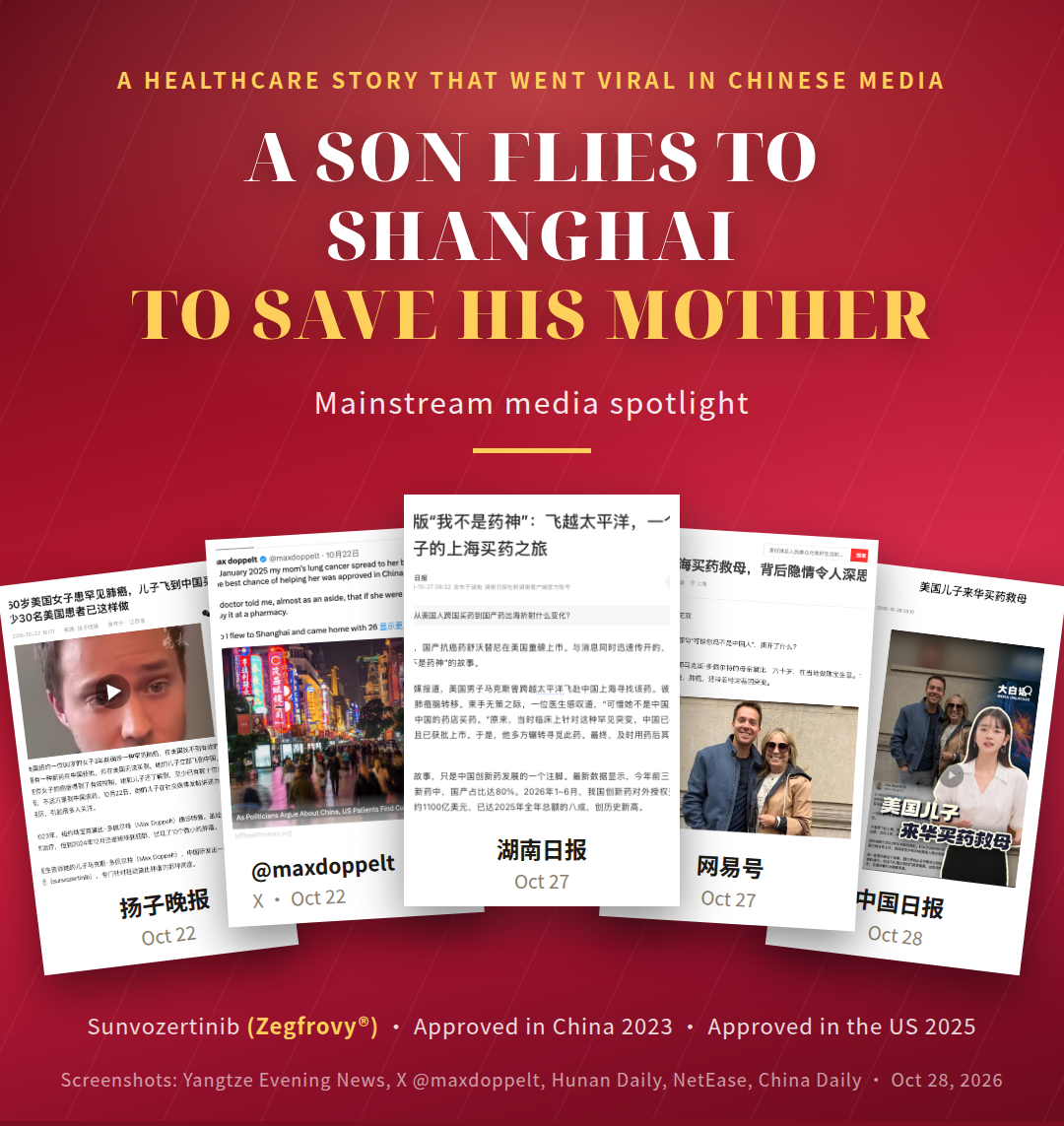
A recent story that went viral in Chinese media illustrates this point remarkably well. First reported by KFF Health News1, it shows what can happen after approval.
When Patients Can't Wait
In 2023, Debbie Doppelt, a 60-year-old New York City jeweler, was diagnosed with lung cancer. By December 2024, the disease had metastasized to her brain. After spending months searching for treatment options, her son eventually traveled to China in January 2025 to obtain a promising experimental drug called sunvozertinib.
At the time, sunvozertinib was still in Phase III clinical development in the United States. Debbie did not qualify for the relevant clinical trials, leaving few alternatives.
Several months later, in July 2025, the FDA granted sunvozertinib accelerated approval.
For most people, that sounds like a happy ending.
It wasn't.
Approval Didn't Mean Availability
The company behind sunvozertinib, China's Dizal Pharmaceutical, had successfully navigated one of the most difficult challenges in medicine: developing an innovative drug and securing FDA approval.
But developing a drug and selling a drug are two very different businesses.
Unlike large multinational pharmaceutical companies, Dizal did not have an established commercial infrastructure in the United States. It lacked the extensive network required for launch execution, payer contracting, market access negotiations, specialty pharmacy distribution, reimbursement support, physician education, and sales force deployment.
As a result, although the drug received FDA approval in July 2025, it was not commercially launched in the United States until October 2026, after Dizal signed a global licensing agreement with AstraZeneca in September 2026.
More than fifteen months separated approval and commercial availability.
During that time:
- Patients could not routinely access the medicine.
- Revenue generation was delayed.
- The patent clock kept running.
- Competitors continued to advance.
Everyone lost.
Why Fifteen Months Matters
Inside most large pharmaceutical companies, a blockbuster launch is planned years before approval arrives.
Commercial teams do not wait for an FDA decision before preparing for launch.
Instead, they work backward from the anticipated approval date.
While Phase III trials are still underway, organizations such as Pfizer, Merck, AstraZeneca, Novartis, and Bristol Myers Squibb are often already:
- Conducting market access planning
- Negotiating payer strategies
- Forecasting demand
- Building distribution channels
- Training sales teams
- Developing physician education programs
- Preparing patient support services
For highly anticipated products, companies frequently begin commercialization planning two or more years before approval.
The goal is simple: launch as soon as possible after regulatory clearance.
In some cases, drugs become available to patients on the same day FDA approval is announced.
Why the urgency?
Because launch momentum matters.
Commercial executives often say that launch momentum is easiest to build at the beginning and difficult to recover once lost.
Physicians are paying attention. Investors are paying attention. Competitors are paying attention.
The first months after launch can significantly influence the trajectory of an asset for years to come.
The Most Underrated Capability in Biopharma
This story highlights a reality that is often overlooked by observers who focus exclusively on science.
Drug development is extraordinarily difficult.
The odds of bringing a molecule from discovery to approval remain daunting. Most candidates fail long before reaching patients.
Yet approval is not the final challenge.
For biotechnology companies, successful commercialization may require an entirely different set of capabilities:
- Market access and reimbursement expertise
- Relationships with payers and providers
- Medical affairs infrastructure
- Regulatory and compliance operations
- Supply chain management
- Global distribution networks
- Sales and marketing execution
- International expansion capabilities
These are precisely the areas where large pharmaceutical companies maintain enormous competitive advantages.
Scientists often view innovation as the creation of a new medicine.
Patients, however, experience innovation only when they can actually obtain that medicine.
The gap between those two realities is filled by commercialization.
A Tale of Two Finish Lines
Biotech entrepreneurs sometimes talk about FDA approval as if it were the finish line.
In practice, there are two finish lines.
The first is regulatory approval.
The second is patient adoption.
The first proves that a therapy works.
The second determines whether the therapy creates real-world impact.
Too often, public discussion stops at the first.
The sunvozertinib story reminds us that getting a drug approved and getting a drug into patients' hands are not the same achievement.
One is a scientific victory.
The other is an operational one.
And in modern biopharma, both are essential.
Many people assume that the hardest part of drug development is obtaining FDA approval. In reality, approval may mark only the halfway point of the journey. The path from "approved" to "accessible" is often longer, more expensive, and more complex than most outsiders realize.
1. KFF Health News, "As Politicians Argue About China, US Patients Find Cutting-Edge Treatment There," October 20, 2026. https://kffhealthnews.org/health-industry/china-cancer-drugs-foreign-travel-pharma-biotech-fda-regulation-clinical-trials/
Other Posts You Might Like