AI-driven drug discovery is experiencing a fascinating paradox. On one hand, Isomorphic Labs, the AI drug discovery company spun out of Alphabet and led by Nobel laureate and AlphaFold co-creator Demis Hassabis, is reportedly seeking funding at a valuation approaching $50 billion. At that level, it would rank among the world's 25 largest biopharmaceutical companies, ahead of established firms such as Bayer, Teva, UCB, and Biogen.
On the other hand, recent analyses, including a Nature Reviews Drug Discovery review¹ and a McKinsey white paper², argue that AI has yet to produce the transformative impact many anticipated in drug discovery and development. Despite extraordinary advances in AI, the long-term decline in R&D productivity, commonly known as Eroom's Law, remains largely unchanged. The common criticism is straightforward: AI generates molecules and hypotheses, while the real bottlenecks remain biological validation, translational science, clinical development, and commercialization.
On October 16, I chaired the inaugural @Philly AI in Biopharma Executive Summit, hosted by SAPA-GP at the Science History Institute in Philadelphia. More than 120 leaders from pharma, biotech, AI, investment, and academic organizations spent a day discussing three questions:
- Where is AI actually creating value in biopharma?
- Where are its limits?
- What would it take to move from pilots to measurable scientific, clinical, and business impact?
The ground rule was candid discussion in the room and discretion outside it. What follows are not direct quotations but themes that emerged throughout the day. The conclusions are my own.
1. Biology Has No Compiler
Generative AI writes fluent prose, codes software, and increasingly proves mathematical conjectures. It is tempting to assume biology is next.
However, for language, code, and math, the ground truth is already captured in abundant data and verification is relatively easy: a compiler, a proof checker, a human reader. In biology the ground truth is not yet in the data. And experiments are slow, expensive, noisy, and sparse.
As Eli Lilly CEO Dave Ricks recently observed, we may understand only 10-15% of human biology³. Some of the most valuable biological insights likely reside in the long tail: rare, unexpected signals hidden in vast amounts of noisy data. Drug discovery scientists have described their work as "finding a needle in a haystack" for decades. If those signals are scarce, weakly represented, or absent from existing datasets, how can AI discover what humans have not already found?
The ultimate verifier remains the wet lab. Yet most experiments fail, and most negative results never enter the scientific record.
The Linguistics of Life
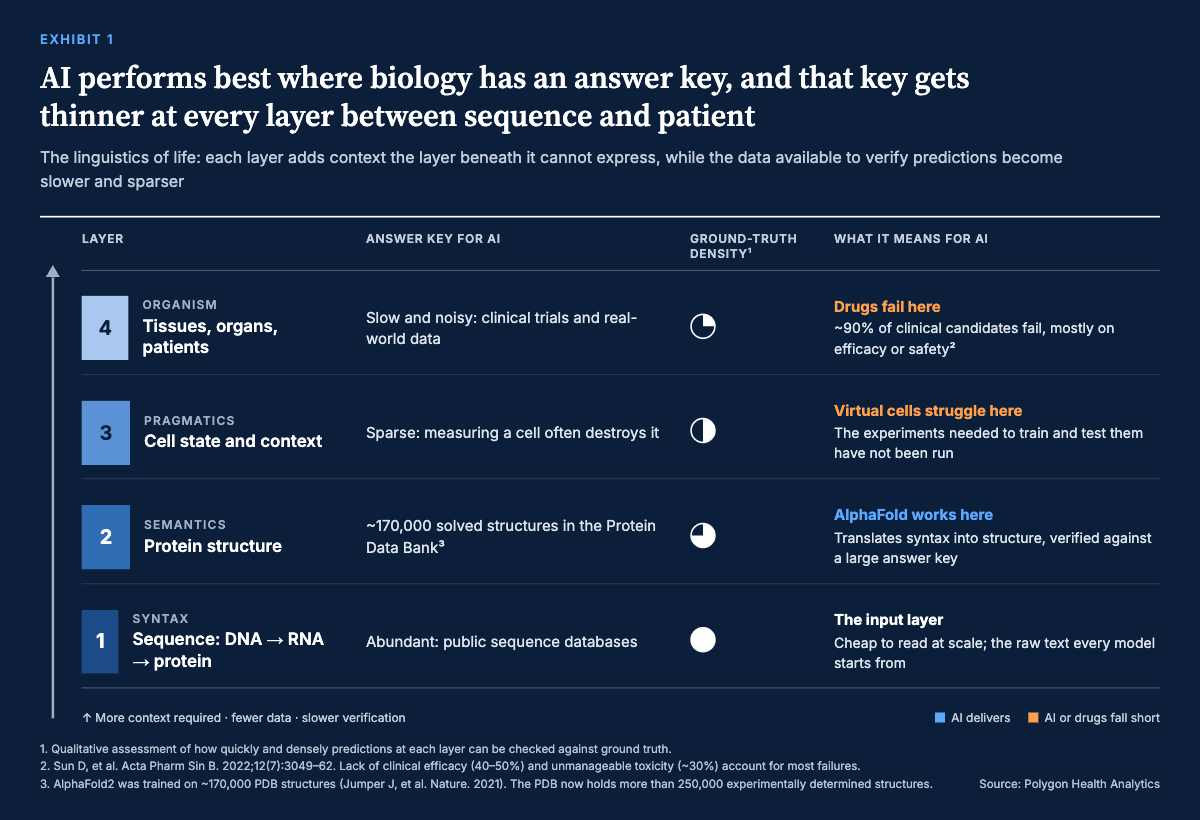
A useful analogy comes from language. The central dogma of molecular biology, DNA → RNA → protein, represents the syntax of life. Protein structure represents semantics: what those biological sentences mean physically. Cell biology represents pragmatics: where, when, and under what conditions molecular machinery operates. Above that sit tissues, organs, and entire organisms, where physiology, environment, and behavior interact in ways that cannot be inferred from lower levels alone. Each layer adds context that the layer beneath it cannot fully express.
Why AlphaFold Succeeded
AlphaFold is often cited as evidence that AI can revolutionize biology. In reality, it succeeded under unusually favorable conditions. Predicting protein structure from sequence is a highly constrained problem governed by physics. Moreover, roughly 170,000 experimentally solved protein structures in the Protein Data Bank provided a massive answer key for training and validation.
AlphaFold solved a translation problem, not a discovery problem. It learned how biological syntax becomes biological structure. What it did not solve are many of the questions that matter most in human disease:
- Protein dynamics
- Intrinsically disordered regions
- Context-specific protein function
- Cellular state transitions
- The effects of mutations across biological environments
These are precisely the areas where comprehensive answer keys do not exist.
Context Is the Missing Variable
The human genome is essentially identical in every cell of the human body, yet neurons, hepatocytes, and immune cells behave very differently. The explanation is not encoded in DNA sequence alone.
It emerges from epigenetic state, spatial organization, developmental history, and temporal regulation. Much of this information is context-dependent and difficult to observe. In many cases, measuring it requires destroying the very biological system being studied.
This helps explain why many ambitious "virtual cell" foundation models have struggled to outperform simple baselines. The regularities these models seek may not yet be present in the data because the necessary experiments have not been performed.
In machine-learning terms, the problem is not merely the model. The problem is the missing training data.
The Organism-Level Challenge
The challenge becomes even greater at the level of tissues, organs, and whole organisms.
One summit speaker presented work on brain aging using MRI data alone. His models learn latent spatial representations of heterogeneity in brain aging without predefined labels. These representations can stratify patients, predict progression, and potentially identify new therapeutic targets. Yet the biological interpretation did not come from the AI itself. Meaning emerged only after linking imaging patterns to proteomic, genetic, and clinical outcome data.
Even more revealing was the observation that identical patterns of brain atrophy can arise through entirely different biological mechanisms. In one patient, the pattern may be driven primarily by amyloid pathology. In another, vascular disease may be the dominant cause. The image alone does not contain its own explanation. This is biology's pragmatics problem made visible.
The Real Bottleneck
Roughly 90% of clinical-stage drug candidates fail, most commonly because of inadequate efficacy or unacceptable safety in humans, not because scientists could not generate a molecule.
The bottleneck is identifying the right target, in the right patient, at the right time. That is fundamentally an organism-level problem. Our strongest predictor of clinical success remains human genetic evidence, which comes from observing people, not generating molecules.
This suggests a more realistic role for AI. AI is unlikely to eliminate the experimental loop. Instead, it can dramatically improve its efficiency by prioritizing better hypotheses, identifying more informative experiments, and extracting stronger signals from observational data.
In this framework, real-world data becomes an organism-scale experiment. Methods such as target trial emulation act as the verifier. Their limitations arise not from model size but from measurement quality, missing data, and confounding.
The limiting reagent for biomedical AI is not computing power. It is high-quality human phenotypic data linked to interventions and outcomes.
2. The Linear R&D Pipeline Was Not Designed for AI
Most AI in biopharma is being layered onto an R&D model designed decades ago: sequential stage gates, siloed functions, and population-average medicine. The system is optimized for controlling risk one step at a time, not for learning across the entire development lifecycle.
A target is often selected eight to twelve years before a Phase III trial reveals whether the biology was right. By then, the teams have changed, the data live in different systems, and few incentives encourage lessons from late-stage successes or failures to inform future target selection. The industry does learn, but slowly. AstraZeneca's "5R" framework⁴, which since 2011 has required every program to show evidence for the right target, right tissue, right safety, right patient, and right commercial potential before advancing, demonstrated that systematically closing the loop can dramatically improve R&D productivity: the company's success rate from candidate nomination to Phase III completion rose from 4% in 2005-2010 to 19% in 2012-2016. But it took nearly a decade to realize those gains.
The problem is not simply organizational. Many design choices embedded in drug development work against AI's strengths. Clinical trials are powered to detect average treatment effects in broad populations. Endpoints are often chosen for regulatory precedent rather than biological precision. Patient selection is constrained by what can be measured routinely. Individually, these decisions are sensible. Collectively, they suppress the heterogeneity that AI is best positioned to uncover.
This is why AI applied to a single step rarely delivers transformative value. A model that improves lead optimization cannot rescue a Phase II trial that enrolled the wrong patients. A site-selection algorithm cannot fix an endpoint that fails to capture meaningful benefit. Most late-stage failures are rooted in earlier decisions about target, patient population, dose, or endpoint.
The larger opportunity is not better point solutions but a continuously learning system. Insights from clinical trials and real-world practice should inform the next target selection decision, the next trial design, and the next patient stratification strategy.
Several presentations offered glimpses of that future. Imaging biomarkers can identify high-risk patients and reduce trial size requirements. Multimodal models that combine genetics, clinical records, and omics data can reveal disease subtypes and progression patterns. The pieces exist.
What remains missing is integration: a shared view of the patient, a shared data layer, and organizational ownership of the learning loop.
Two cautions are important.
First, stage gates exist to protect patients. AI's influence on development decisions should expand only as evidence of its reliability grows. Trust must be earned through demonstrated credibility, not assumed.
Second, medicine is not software. Trial outcomes take years to emerge, and human health is the ultimate benchmark. A model that tops a leaderboard has not necessarily helped a single patient.
Several speakers from very different perspectives converged on the same principle: Validate AI where decisions are made, and against human outcomes, not benchmark leaderboards.
3. In Clinical Development, the Wins Are Real, Small, and Difficult to Aggregate
The clinical-development track was perhaps the most grounded part of the summit because it focused on deployed systems rather than future visions.
The pattern was remarkably consistent. There is no single transformational AI application in clinical development. Instead, gains accumulate across dozens of activities: country and site selection, patient recruitment, eligibility screening, data quality monitoring, statistical programming, medical writing, and regulatory documentation.
Two examples stood out. One organization described building an enterprise digital-pathology platform with AI coding agents in a matter of months. Another demonstrated an explainable, human-in-the-loop site-selection system built atop a governed enterprise data platform.
Whether they matter depends on two factors.
The first is the critical path. Patient recruitment alone accounts for roughly 30% of development timelines. Saving an hour on a non-critical task reduces cost. Shortening recruitment by a week changes when patients receive therapy.
The second is judgment. As programming, analysis, and writing become cheaper, output explodes. In one live Phase II trial, a ten-person clinical team used AI tools to run more than 1,800 statistical analyses in a few months, an output that would have taken far longer with conventional programming. Every one of those analyses still requires a person to judge whether it is correct, meaningful, and actionable. The scarce resource is increasingly expert review.
The benchmark data discussed were sobering. Leading models perform extremely well on routine analyses, significantly worse when rules must be interpreted from a protocol, and nearly always wrong when the dataset contains a defect that nobody has pointed out.
Moreover, a second AI model is not necessarily an independent check. State-of-the-art models often make correlated mistakes. True independence still comes from a different person, a different process, or the source data itself.
This is also why ROI remains difficult to quantify. Hours saved rarely translate directly into faster programs, and many organizations still make build-versus-buy decisions based on upfront cost or fear of missing out.
Organizations that learn to measure cycle time, decision quality, and avoided failures rather than task efficiency will be the first to understand where AI creates real value.
4. Aging Is a Case Study in How Far the Evidence System Must Evolve
The opening keynote argued that aging itself should be treated as a therapeutic target.
The example was compelling: an AI-nominated target implicated in multiple hallmarks of aging, a purpose-built inhibitor, an initial indication in idiopathic pulmonary fibrosis, and a Phase IIa study reporting both improved lung function and favorable shifts in proteomic aging clocks.
The science is exciting. The evidentiary path is even more instructive, because this one program concentrates nearly every regulatory challenge the field will face.
Start with the indication. Regulators do not recognize aging as a disease, so there is no settled answer to the most basic trial design question: who should be enrolled, and what counts as success? That is why the program began in a recognized disease, idiopathic pulmonary fibrosis, framed as a form of accelerated aging.
Next, the endpoint. Aging clocks remain unvalidated surrogates. A favorable shift in a proteomic clock after a lung drug improves lung function could reflect a true systemic effect on aging, or simply a healthier set of lungs. Separating the two requires a study designed for that purpose, not a secondary readout from a disease trial.
Then, the evidence itself. The signal came from a small, short trial in a single disease population. Confirming it will require larger studies with longer follow-up, and late-stage trials in a chronic indication are long and expensive. That cost, in turn, leaves the business model unresolved: whether the company licenses the asset or develops it fully will shape which evidence is ever generated.
None of this is a criticism of the program. It is a reminder that the hardest part of building a new therapeutic category is rarely the molecule. It is the indication, the endpoint, the surrogate, and the trial design. Those are evidence problems, and no amount of AI at the discovery stage makes them go away.
Ultimately, the central challenge is verification.
The field has become extraordinarily good at generating hypotheses. Whether AI bends Eroom's Law will depend on whether it can also accelerate the process of proving which hypotheses are true.
¹ Bender A, Thomas MC, Scannell JW, et al. Artificial intelligence in drug discovery: what it is, where we stand and the path forward. Nature Reviews Drug Discovery (2026).
² McKinsey & Company. AI Drug Discovery: Focusing on What Matters Most.
³ Ricks D. Interview with John Collison. Cheeky Pint podcast, episode 18 (November 2025). https://cheekypint.substack.com/p/dave-ricks-ceo-of-eli-lilly-on-glp
⁴ Cook D, Brown D, Alexander R, et al. Lessons learned from the fate of AstraZeneca's drug pipeline: a five-dimensional framework. Nature Reviews Drug Discovery 13, 419-431 (2014).
Other Posts You Might Like