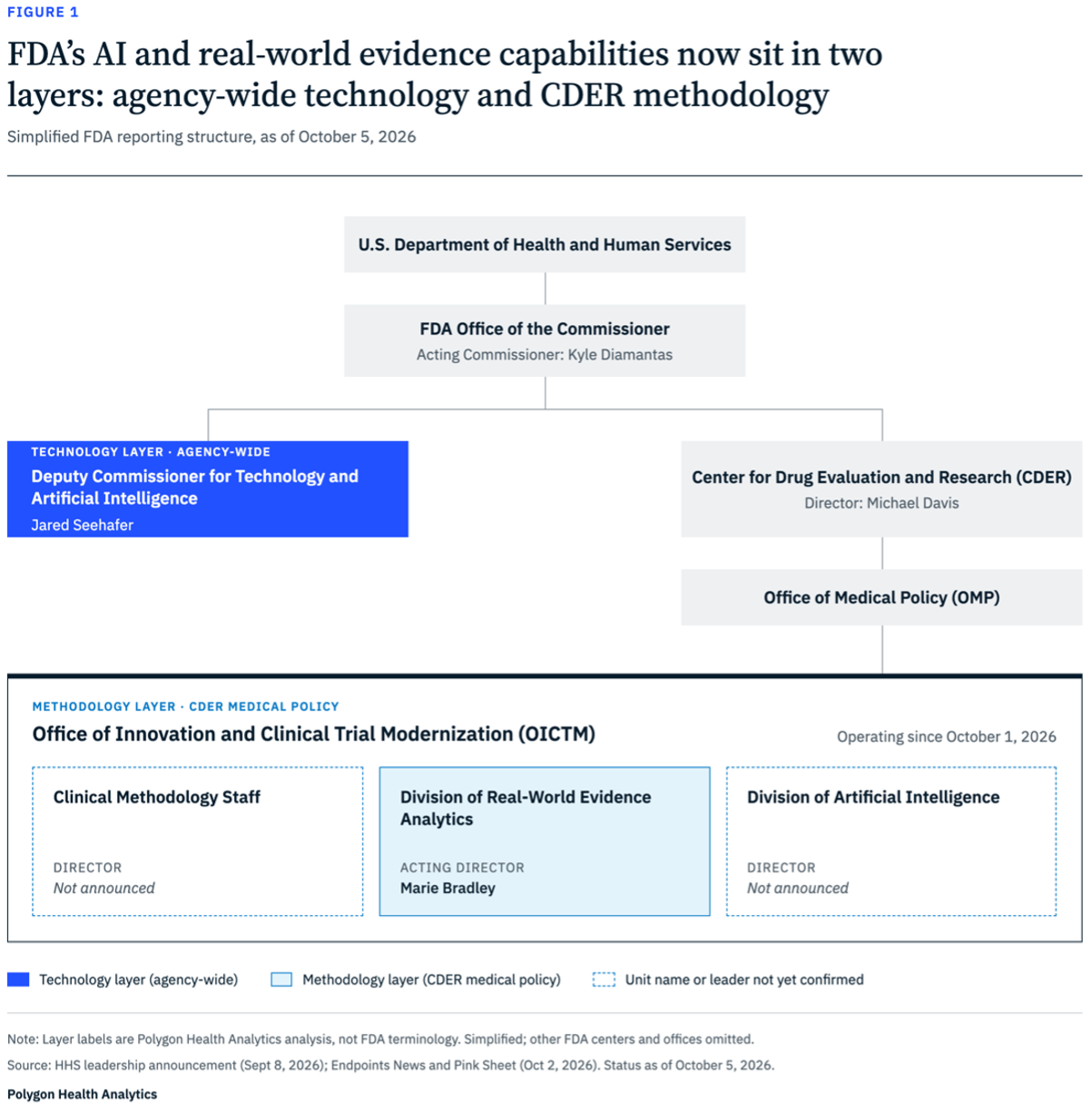
On October 1, FDA's Center for Drug Evaluation and Research (CDER) began operating a new Office of Innovation and Clinical Trial Modernization (OICTM) within its Office of Medical Policy (OMP) [1,2]. The office houses three units: a Division of Artificial Intelligence, a Division of Real-World Evidence Analytics led by acting director Marie Bradley, and a Clinical Methodology Staff [1,2] (Figure 1).
The office's stated purpose is broader than AI: it is part of FDA's push to speed up and modernize clinical trials [2]. But where FDA chose to put its AI division is telling. In our view, it signals that FDA will judge AI-generated evidence as a scientific question, not a software question. In our experience, many sponsors are not yet organized that way. AI decisions are often made by IT or data science teams. The people who will have to defend an AI-derived result to FDA (epidemiologists, biostatisticians, regulatory scientists) enter only after the model is built.
A Methodology Home, Not a Technology Home
OMP has been the home to CDER's Real-World Evidence (RWE) Program [4], which operates under the framework FDA published in December 2018 [3]. That framework evaluates real-world evidence through three questions:
- Are the real-world data fit for use?
- Can the study design provide adequate scientific evidence to answer the regulatory question?
- Does the study conduct meet FDA regulatory requirements?
With the new office, RWE analytics now has its own division and a designated acting director [1,2]. Division status gives the function its own leadership and reporting line, and potentially dedicated staff and budget. It signals that FDA treats real-world data analysis as a standing regulatory capability rather than one activity within a broader program.
Placing the AI division beside it suggests AI-generated evidence will be judged through the same lens. FDA's January 2025 draft guidance points the same way. It proposes a risk-based framework for establishing an AI model's credibility within a defined context of use [5]. Under that framework, credibility depends less on model architecture than on whether the model can reliably support the specific conclusion being drawn. That is work for epidemiologists, statisticians, clinicians, and regulatory scientists, not for engineers alone.
The volume is already substantial. FDA has reported experience with more than 500 drug and biologic submissions containing AI components since 2016 [6], and an FDA landscape analysis documented rapid growth in such submissions between 2016 and 2021 [7].
Two Layers of AI Governance
In September, HHS created FDA's first Deputy Commissioner for Technology and Artificial Intelligence, responsible for agency-wide technology, software, and AI strategy [8]. The role is filled by Jared Seehafer, co-founder and former CEO of Enzyme, a quality management system (QMS) software company for life sciences [9]. CDER Director Michael Davis has also framed AI as a tool to recover institutional knowledge [10] after the center posted a net loss of 1,093 employees in fiscal year 2025 [11].
Taken together, we see FDA building two complementary layers of AI governance (Figure 1):
- The technology layer focuses on platforms, infrastructure, and enterprise adoption.
- The methodology layer focuses on evidence generation, validation, and regulatory credibility.
For sponsors, the lesson is not to copy FDA's org chart. It is to settle decision rights. Who in your organization has the authority, and the accountability, to decide whether an AI-generated result is robust enough to support a regulatory decision? Our answer: the scientists who will defend the result in front of FDA, not the team that built the model.
What Sponsors Should Do Now
Name a scientific owner for every credibility case. Some AI uses touch a submission: patient selection, external control construction, endpoint ascertainment from clinical notes. For each one, a single person should be accountable for the context of use, the model-risk assessment, and the credibility plan. Engineers can build the model. The owner should sit in clinical development, biostatistics, epidemiology, or regulatory affairs, because that is who will defend it in a Type C meeting.
Treat AI on real-world data as two compounding validity problems. Suppose a language model extracts a phenotype from EHR notes, and that phenotype defines an external comparator. The model's misclassification then stacks on top of the data source's confounding and selection bias. Recent statistical work on AI-enabled RWE in oncology identifies reproducibility, bias, transportability, and uncertainty quantification as open problems [12]. Validation against chart review in the target population belongs in the evidence package, not in an IT QA log.
Measure regulatory outcomes, not deployment counts. Metrics such as "models in production" and "hours saved" reward operational wins. If AI is meant to strengthen evidence, track whether AI-derived analyses held up under agency feedback, and whether the credibility documentation was ready before FDA asked for it.
What to Watch Next
Three developments will show whether OICTM becomes a real regulatory capability or remains an organizational announcement.
- Permanent leadership for the AI division. The appointment will show which expertise FDA values most and how it intends to put AI oversight into practice.
- A final AI credibility guidance. The draft laid the foundation [5]. The final version should clarify expectations for validation, documentation, and life-cycle maintenance.
- Dedicated resources in the next PDUFA cycle. Budget authority, staffing, and formal commitments in the next user-fee negotiations will show how central this work becomes to FDA's strategy.
An office without funding and personnel is a press release. An office with sustained resources becomes infrastructure.
The Bottom Line
AI will increasingly be judged by the credibility of the evidence it produces, not by the sophistication of the technology behind it. The sponsors that succeed will not be the ones with the most models. They will be the ones that can show their AI-enabled evidence is fit for purpose, scientifically valid, and ready for regulatory review.
At Polygon Health Analytics, we work at the intersection of data quality, study design, epidemiology, and model validation. The failure we see most often is not a weak model. It is a capable model with no one positioned to defend it. FDA has now organized itself to ask the questions. Sponsors should be organized to answer them before their next submission, not after the first information request.
References
- Osman M. US FDA innovation, clinical trial modernization office reflects CDER analytics, AI focus. Pink Sheet [Internet]. 2026 Oct 2 [cited 2026 Oct 5]. Available from: https://insights.citeline.com/pink-sheet/agency-leadership/us-fda/us-fda-innovation-clinical-trial-modernization-office-reflects-cder-analytics-ai-focus-AXYAJBVF45FGXGHCU2UODVPZFY/
- Bayer M. FDA launches new clinical trial modernization office within CDER. Endpoints News [Internet]. 2026 Oct 2 [cited 2026 Oct 5]. Available from: https://endpoints.news/fda-opens-clinical-trial-modernization-office-in-cder/
- U.S. Food and Drug Administration. Framework for FDA's Real-World Evidence Program [Internet]. Silver Spring (MD): FDA; 2018 [cited 2026 Oct 5]. Available from: https://www.fda.gov/media/120060/download
- U.S. Food and Drug Administration. Office of Medical Policy [Internet]. Silver Spring (MD): FDA [cited 2026 Oct 5]. Available from: https://www.fda.gov/about-fda/cder-offices-and-divisions/office-medical-policy
- U.S. Food and Drug Administration. Considerations for the use of artificial intelligence to support regulatory decision-making for drug and biological products: draft guidance [Internet]. Silver Spring (MD): FDA; 2025 [cited 2026 Oct 5]. Available from: https://www.fda.gov/regulatory-information/search-fda-guidance-documents/considerations-use-artificial-intelligence-support-regulatory-decision-making-drug-and-biological
- U.S. Food and Drug Administration. FDA proposes framework to advance credibility of AI models used for drug and biological product submissions [Internet]. Silver Spring (MD): FDA; 2025 [cited 2026 Oct 5]. Available from: https://www.fda.gov/news-events/press-announcements/fda-proposes-framework-advance-credibility-ai-models-used-drug-and-biological-product-submissions
- Liu Q, Huang R, Hsieh J, Zhu H, Tiwari M, Liu G, et al. Landscape analysis of the application of artificial intelligence and machine learning in regulatory submissions for drug development from 2016 to 2021. Clin Pharmacol Ther. 2023;113(4):771-4. doi:10.1002/cpt.2668
- U.S. Department of Health and Human Services. HHS announces key FDA leadership selections [Internet]. Washington (DC): HHS; 2026 [cited 2026 Oct 5]. Available from: https://www.hhs.gov/press-room/hhs-announces-key-fda-leadership-selections.html
- FDA makes acting CDER, CBER chiefs permanent. pharmaphorum [Internet]. 2026 Sep [cited 2026 Oct 5]. Available from: https://pharmaphorum.com/news/fda-makes-acting-cder-cber-chiefs-permanent
- Osman M. CDER Director Mike Davis eyes AI as solution to institutional memory loss. HBW Insight [Internet]. 2026 Sep 21 [cited 2026 Oct 5]. Available from: https://insights.citeline.com/hbw-insight/health/policy-and-regulation/cder-director-mike-davis-eyes-ai-as-solution-to-institutional-memory-loss-VRYREBZZN5AJ3FHOKDVUSKN3KU/
- Becker's Hospital Review. 2 FDA research centers see attrition in 2026 amid leadership turnover [Internet]. 2026 [cited 2026 Oct 5]. Available from: https://www.beckershospitalreview.com/uncategorized/2-fda-research-centers-see-attrition-in-2026-amid-leadership-turnover/
- Gao, L., Feng, D. & Yu, B. AI-Enabled Real-World Evidence in Oncology: A Statistical Perspective for Regulatory Decisions. Ther Innov Regul Sci (2026). https://doi.org/10.1007/s43441-026-01036-5
Other Posts You Might Like